Normal Bloodwork but Still Losing Hair: What Your Labs May Miss
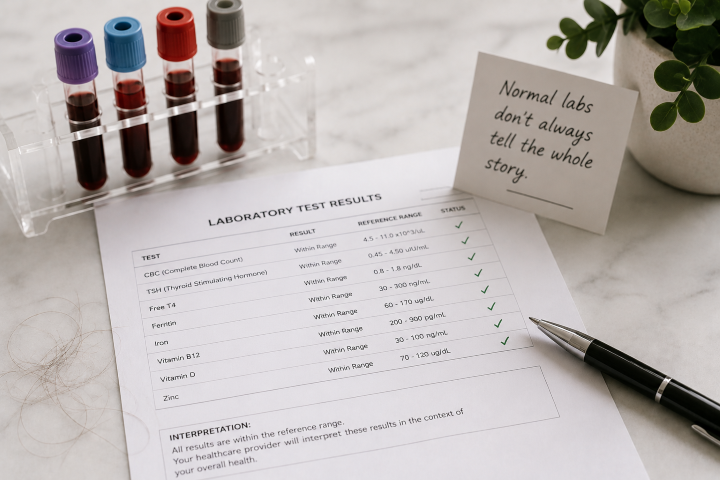
Your Labs Are Normal. So Why Is Your Hair Still Thinning?
One of the most frustrating things a person can hear when they are experiencing hair loss is, “Your labs look normal.”
On one hand, normal bloodwork can be reassuring. It may mean there is no obvious thyroid issue, anemia, or major deficiency showing up on standard testing. But if your hair is still shedding, your part is widening, your ponytail feels smaller, or your scalp feels different than it used to, “normal” can also feel confusing.
You may leave the appointment wondering, “If everything is normal, why does my hair not feel normal?”
This is a very common experience. And it does not mean you are imagining the change.
It means we may need to look at the hair and scalp from a different angle.
Bloodwork is Important, but it is Not the Whole Picture
Bloodwork can be an important part of understanding hair loss. It can help identify internal factors such as low iron, vitamin D, B12, zinc, thyroid imbalance, inflammation, or hormonal shifts. These are all worth discussing with your medical provider when hair loss is persistent or unexplained.
But labs are only one layer of the picture.
Hair loss is not always caused by something that shows up clearly on standard bloodwork. Sometimes the issue is happening at the scalp level. Sometimes it is related to the hair cycle. Sometimes it is a combination of mild internal imbalances, scalp inflammation, stress, hormonal sensitivity, nutrition, and genetics.
In other words, hair loss is often a pattern, not a single lab result.
“Normal” Does Not Always Mean Optimal for Hair
A lab value can fall within a standard reference range and still not tell the full story of what your hair needs.
Reference ranges are designed to help identify disease or major abnormalities. They are not always designed to answer the more specific question: “Is my body in the best possible state to support healthy hair growth?”
For example, someone may not be clinically anemic, but their iron stores may still be worth reviewing. Someone may have thyroid labs that are technically in range but still be experiencing symptoms that deserve a closer conversation with their provider. Someone may have “normal” hormones but still have follicle sensitivity to hormonal changes.
This does not mean you should self-diagnose or chase every number. It means that hair concerns deserve a more complete conversation.
The Scalp Has Its Own Story
The scalp is not just the place where hair comes out. It is living skin with its own barrier, circulation, microbiome, oil production, hydration levels, pH, inflammation patterns, and follicle environment.
A person can have normal bloodwork and still have a scalp that is oily, congested, inflamed, dehydrated, itchy, flaky, sensitive, or showing signs of follicular stress.
This matters because healthy hair needs a healthy environment to grow from.
If the follicle opening is blocked with buildup, if the scalp is inflamed, if sebum is oxidizing around the follicle, or if the scalp barrier is disrupted, growth-focused treatments may not work as well as expected.
This is why we often say: heal first, then grow.
Shedding and Thinning Are Not the Same Thing
Another reason “normal labs” can feel confusing is that people often use the phrase “hair loss” to describe several different things.
Shedding means more hair is falling out than usual. This can happen after stress, illness, rapid weight loss, postpartum changes, medication changes, hormonal shifts, or nutritional disruption.
Thinning can mean the hair shaft is becoming finer over time. This is often related to miniaturization, where the follicle produces thinner, shorter, weaker hairs.
Lower density means there are fewer visible hairs in a given area.
Scalp imbalance means the skin environment may be irritated, oily, dry, inflamed, flaky, or congested.
These can overlap, but they are not identical. A person may be shedding heavily with no miniaturization. Another person may not shed much at all, but gradually notice a wider part because the hairs are becoming finer. Someone else may have both.
A standard lab panel may not show which of these patterns is happening.
That is where scalp and hair analysis become valuable.
What a Scalp Analysis Can Reveal
A detailed hair and scalp analysis allows us to look at what is happening more directly.
We can evaluate the scalp condition, follicle openings, visible buildup, oil levels, hydration, redness, scaling, density, hair shaft diameter, and signs of miniaturization. We can also compare areas of concern and track changes over time.
This kind of information helps answer questions that bloodwork alone cannot answer, such as:
- Is the scalp inflamed?
- Is there excess sebum or buildup?
- Is there dry or oily dandruff?
- Are the follicle openings congested?
- Is the hair shaft becoming finer?
- Is there a difference between shedding and miniaturization?
- Does the scalp need rebalancing before growth stimulation?
- Are we seeing early changes before they become more visible?
This is not about replacing medical testing. It is about adding a missing layer of information.
Why Guessing Can Waste Time
When someone is told their labs are normal, they often start trying random solutions. A new supplement. A trending oil. A stronger shampoo. A growth serum. A scalp scrub. A medication. A laser cap. Another supplement.
The problem is that without understanding the actual pattern, it is easy to do too much or choose the wrong starting point.
If the scalp is already irritated, aggressive products can make it worse. If there is buildup, growth actives may not reach the scalp effectively. If the main issue is miniaturization, a simple “hair shedding” approach may not be enough. If the main issue is telogen effluvium, panic-driven over-treatment may create unnecessary stress.
The goal is not to throw more at the hair.
The goal is to understand what the hair and scalp are asking for.
When to Keep Working with Your Medical Provider
There are times when medical evaluation is especially important. If hair loss is sudden, patchy, painful, accompanied by scalp sores, associated with heavy fatigue or other systemic symptoms, or progressing quickly, it is important to speak with a physician or dermatologist.
It is also worth discussing bloodwork if your shedding is persistent or unexplained. Depending on your situation, your provider may evaluate thyroid markers, iron/ferritin, vitamin D, B12, zinc, hormones, inflammation, autoimmune markers, or other factors.
A trichology consultation does not replace medical care. It works best as part of a more complete picture.
The Emotional Side of “normal”
Being told everything is normal can feel invalidating when you know something has changed.
Hair loss is deeply personal. You may notice small changes long before anyone else does. You may feel the difference when you wash your hair, style it, put it in a ponytail, or look at photos. These details matter.
At âme vitality, we take those observations seriously.
You do not need to wait until hair loss is severe to begin investigating. In fact, earlier support is often better because we can identify subtle scalp and follicle changes before they become more advanced.
The Takeaway
Normal labs are good information, but they are not the end of the conversation.
If your hair is still shedding, thinning, or changing, there may be more to understand. Your scalp environment, hair cycle, follicle health, density, shaft diameter, inflammation, stress, nutrition, and hormonal sensitivity can all play a role.
The question is not simply, “Are your labs normal?”
The better question is, “What is your hair and scalp showing us?”
A Hair & Scalp Diagnostic Consultation helps us look more closely, connect the dots, and create a plan based on what is actually happening rather than guessing.
Because when we understand the pattern, we can support the hair more intelligently.